
SHIMMER DATABASE
The database was developed with the objective of compiling and organizing essential information as a comprehensive digital repository. The significance of the database lies not only in its status as a comprehensive European-wide information repository, but also due to the information gathered from great range of sources, including open-source information, as well as data collected from participating European transmission and distribution system operators (TSOs and DSOs) and previous international projects.
While we made every attempt to ensure that the information contained in this site provides a comprehensive view on the European natural gas network and represents material wise its diversity, it was provided by the following participating transmission and distribution gas operators participating in the project: Gassco (Norway), Gaz-System (Poland), SNAM (Italy), and Enagas (Spain) as operators of high-pressure transmission systems for natural gas and Inrete (Italy) and Redexis (Spain), as operators for local distribution of natural gas to end users within regional networks. The total length of pipeline included in the database is: 43,195 km, which is approximately 2.2% of the total estimated pipeline length in Europe.
In details the Shimmer Database covers about 14.3% of the transmission pipeline network and 0.8% of the distribution pipeline network across the EU shown in the following figure [1].
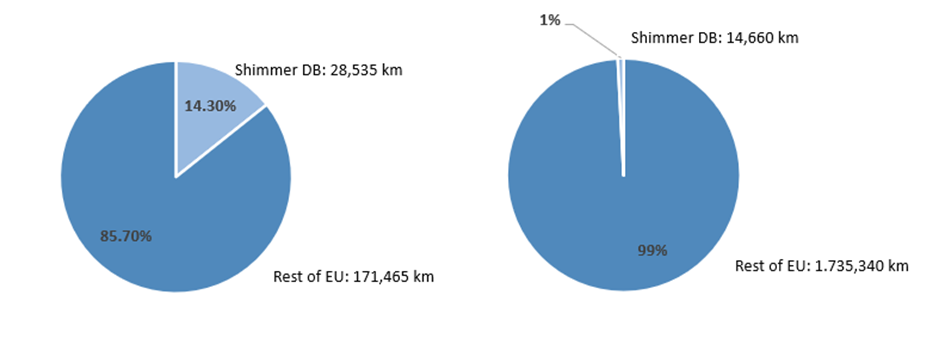
Distribution of pipeline distance covered in SHIMMER with relationship to the European TSO (a) and DSO (b) infrastructure.
The Shimmer database contains detailed information on a large variety of components utilized in natural gas infrastructure. This includes pipelines, valves, fittings, gaskets, and compressors, all of which are essential for ensuring the safe and reliable operation of transmission and distribution systems. The data is accessible in the category: Components in Energy Infrastructure
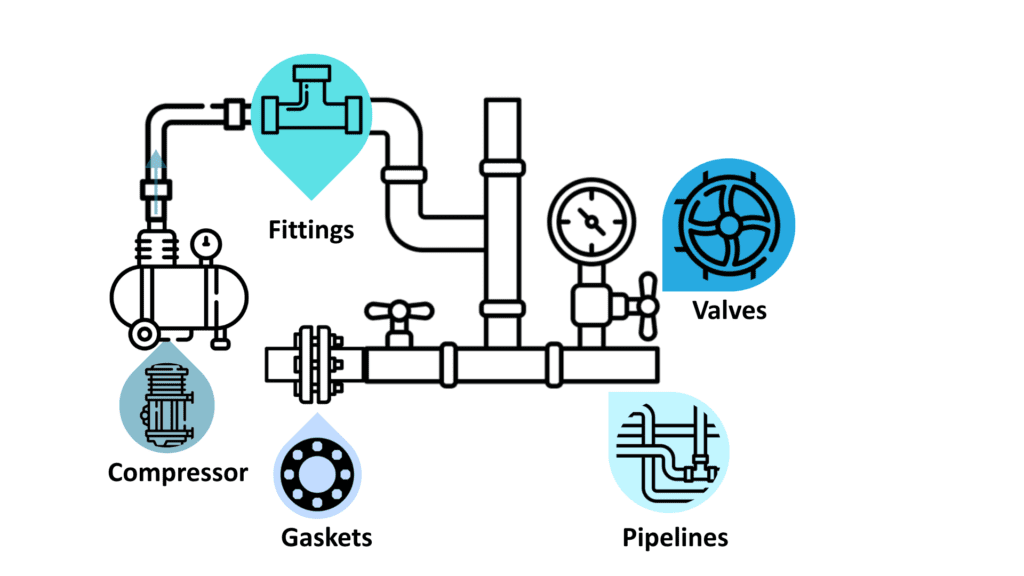
Data categorization
We have divided the database into the following 7 main categories to ensure better organization and accessibility on the website.

Components in Energy Infrastructure
This section provides structured datasets covering key components in gas networks across Europe. The information can assist in the evaluation of hydrogen compatibility by compiling robust data from TSOs and DSOs. The category includes data on pipelines, valves, gaskets, and fittings, gathered from several sources and presented in an organized format for easy access and comparison.
- General information on pipelines
- General information on valves
- General information on fittings
- General information on gaskets
- General information on compressors
- Pipeline data from Transmission System Operators
- Pipeline data from Distribution System Operators

Hydrogen Injection Regulations and Odorization Practices
This category brings together information on the limitations of hydrogen injection into natural gas networks and a summary of gas odorization substances used across Europe. The tables are based on information provided by Marcogaz in two publications. The report “Hydrogen Regulation” (2024) compiles national and EU-level requirements for the injection of hydrogen into natural gas networks. Additionally, the report “Natural Gas Odorisation Practices in Europe” (2023) provides an overview of odorization applied by operators across different member states.
- Regulations for hydrogen injection into natural gas
- Natural gas odorisation practices in EU
- Gathered information from participating TSOs and DSOs

Materials Used in Gas Grid Components and Their Compatibility with Hydrogen
- Pipeline material compatibility with hydrogen
- Valve body and bonnet materials compatibility with hydrogen
- Valve trim materials compatibility with hydrogen
- Flange material compatibility with hydrogen
- Gasket material compatibility with hydrogen
- Polymer material compatibility with hydrogen
- Typical material used in gas grid compatibility with hydrogen
- Hydrogen material compatibility for pressure applications

Standards and Technical Standardization Committees
This category comprises guidelines from the international standardization organization (ISO) and other standardization organizations, focusing on the oil and gas industry divided by relevant committees, guidelines, and specifications for assessing material compatibility with hydrogen.
- ISO technical committees for use in the oil and gas industry
- Standards for material testing

Reports on Material Testing from selected projects
The table is based on investigation conducted as part of two distinct projects. Firstly, the SyWest H2 project, which was conducted by the “German association for gas and water” (DVGW). In this project, selected steels used for natural gas pipelines and plants were analyzed and their suitability with hydrogen was assessed. Secondly, the “HIGGS Project report presents important findings on material performance in hydrogen environments, addressing concerns such as embrittlement and degradation.
- Material testing reports

This category provides insights from ongoing and completed hydrogen-related projects across Europe, as well as examples from international databases.
- European pilot projects
- Related databases

This section presents a selected comprehensive and detailed comparison of the data obtained from the database.
bam.de/Content/DE/Projekte/ModuH2Pipe/ModuH2Pipe.html
candhy.eu
pilgrhym.eu
higgsproject.eu
sintef.no/en/projects/2020/cleanexport
sintef.no/en/projects/2019/hyline-safe-pipelines-for-hydrogen-transport
hydeploy.co.uk
gerg.euprojects/hydrogen/removing-the-technical-barriers-to-use-of-hydrogen-in-natural-gas-networks-and-for-natural-gas-end-users
wasserstoff-leitprojekte.de/projects/transhyde
thyga-project.eu
greenhysland.eu
exolum.com/en/proyecto/greenh2pipes-en/
dvgw.de/themen/forschung-und-innovation/forschungsprojekte/dvgw-forschungsprojekt-h2-tauglichkeit-von-staehlen
thoth2.eu
nhyra.eu
nationalgas.com/insight-and-innovation/transmission-innovation/futuregrid
lut.fi/en/hygcel
dlr.de/en/ff/research-and-transfer/projects/2018/h2loop
hydelta.nl/hydelta-1-0
hydelta.nl/hydelta-2-0
hydelta.nl/hydelta-3-0
grande-region-hydrogen.euen/projects/mosahyc
hypster-project.eu
met4h2.eu
decarbgrid.eu
storeandgo.info