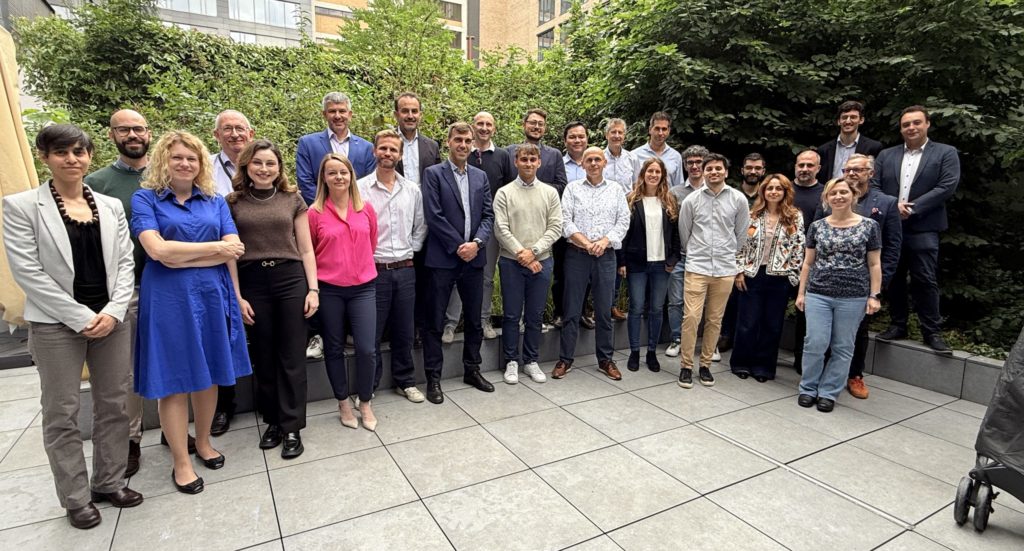
The SHIMMER project partners held their final project meeting in Brussels on Wednesday, 9 June. Project partner GERG – The European Gas Research Group hosted the consortium to review the project’s results and define final steps to be taken before the project conclusion in August. The consortium also took the opportunity to present its results during a joint workshop with the European project CANDHy.
The day began with the project’s final meeting, which opened with welcoming remarks from Robert Judd, Secretary General of GERG. Diana González, Research Scientist at SINTEF and SHIMMER Project Coordinator, then introduced the meeting with an overview of the project’s positive progress and overall achievements.
The first technical session focused on progress made on the SHIMMER Database, presented by Nilsah Ekici, Research Assistant at the German Federal Institute for Materials Research and Testing (BAM). The SHIMMER Database is a repository containing information on materials and components used in the existing European gas infrastructure. It brings together harmonised technical data from TSOs, DSOs, scientific literature and open sources, ensuring consistency across different European regions. The database also consolidates information on materials, components and operational conditions relevant to hydrogen service, including pipelines, valves, fittings and associated infrastructure equipment.
The following session focused on the project’s findings aimed at establishing a basis for managing integrity and safety in existing gas grids operating with hydrogen-natural gas blends. First, Nevena Marinova, Researcher at Tecnalia, presented the material selection process, the properties reviewed and the assessment of the compatibility of existing natural gas infrastructure with H₂-NG blends. Gaz-System then shared the results of its investigations into the detection of material defects in pipelines that could affect hydrogen transport. This was followed by Jadwiga Holewa Rataj, head of the Department of Petroleum Engineering at the Polish Gas and Oil Institute, who presented the conclusions of its research evaluating the leak detection methods most commonly used by TSOs and DSOs, as well as laboratory tests carried out with mixtures containing up to 20% and 80% hydrogen.
The meeting then turned to results related to hydrogen flow assurance and blending with natural gas in gas grids. Huib Blokland, Project Manager in Energy Transition at TNO, presented the results from the tests carried out on different gas quality measurement technologies to determine which ones are suitable and which should be discarded. Lars Hellemo, Senior Research Scientist at SINTEF, then presented the work carried out to develop EnergyModelsGasNetworks, an open-source tool designed to support the optimisation of hydrogen integration into gas networks by assessing capacity, investments, routing and infrastructure expansion options. Ryvo Octaviano, Senior Scientist in Energy Transition at TNO, showcased the results of four hydrogen blending injection case studies – two in TSO networks and two in DSO networks in Italy and Spain – which have contributed to the development of operational guidelines for the safe injection of hydrogen into natural gas networks. Finally, Marco Cavana, PhD Research Assistant at the Polytechnic University of Turin, outlined recent progress in developing statistical methodologies to enable broader generalisation on the readiness of gas infrastructure for hydrogen blending.
Following the technical sessions, attention turned to the project’s impact among stakeholders in the hydrogen sector. Ludovico Mazzocco, Project Officer at GERG, presented the conferences where SHIMMER partners have shared project progress, the synergies established with other European projects, and the publications produced as part of the project. Finally, Diana González concluded the meeting with an update on SHIMMER’s administrative status.
SHIMMER-CANDHy Cluster Workshop
Following the review of SHIMMER’s progress, the consortium held the 3rd SHIMMER-CANDHy Cluster Workshop together with the CANDHy project. The event brought together stakeholders to exchange the latest findings on the integration of gas distribution networks operating with hydrogen and hydrogen-natural gas blends.
SHIMMER partners presented updates on ongoing efforts to enhance hydrogen integration in gas networks. This included an overview of the SHIMMER++ tool, used for parametric analysis of gas flow and mixing behaviour in network infrastructures, as well as the SHIMMER Database, which consolidates information on materials and components used in existing European gas infrastructure. The project partners also shared progress on the assessment of gas leak detection methods for natural gas-hydrogen mixtures.
Next, CANDHy project representatives to exchanged their latest findings on the integrity and performance of non-steel metallic natural gas distribution networks operating with hydrogen and hydrogen–natural gas blends. Virginia Madina from Tecnalia presented CANDHy’s experimental campaigns on non-steel metallic materials exposed to a range of hydrogen concentrations. Jean-Baptiste Jorcin, also from Tecnalia, introduced the CANDHy database, which compiles data on the hydrogen compatibility of metals. Finally, Marina Cabrini from the University of Bergamo presented insights from a semi-empirical model developed to identify hydrogen-induced embrittlement in metallic materials.